The Epley Maneuver Explained: What It Is and When You Need Help
Carly Clevenger, PT, DPT••8 min read
The Epley maneuver resolves BPPV in 80-98% of cases when performed by a specialist. Learn what the Epley maneuver is, why DIY attempts often fail, and when to see a vestibular therapist for vertigo treatment.
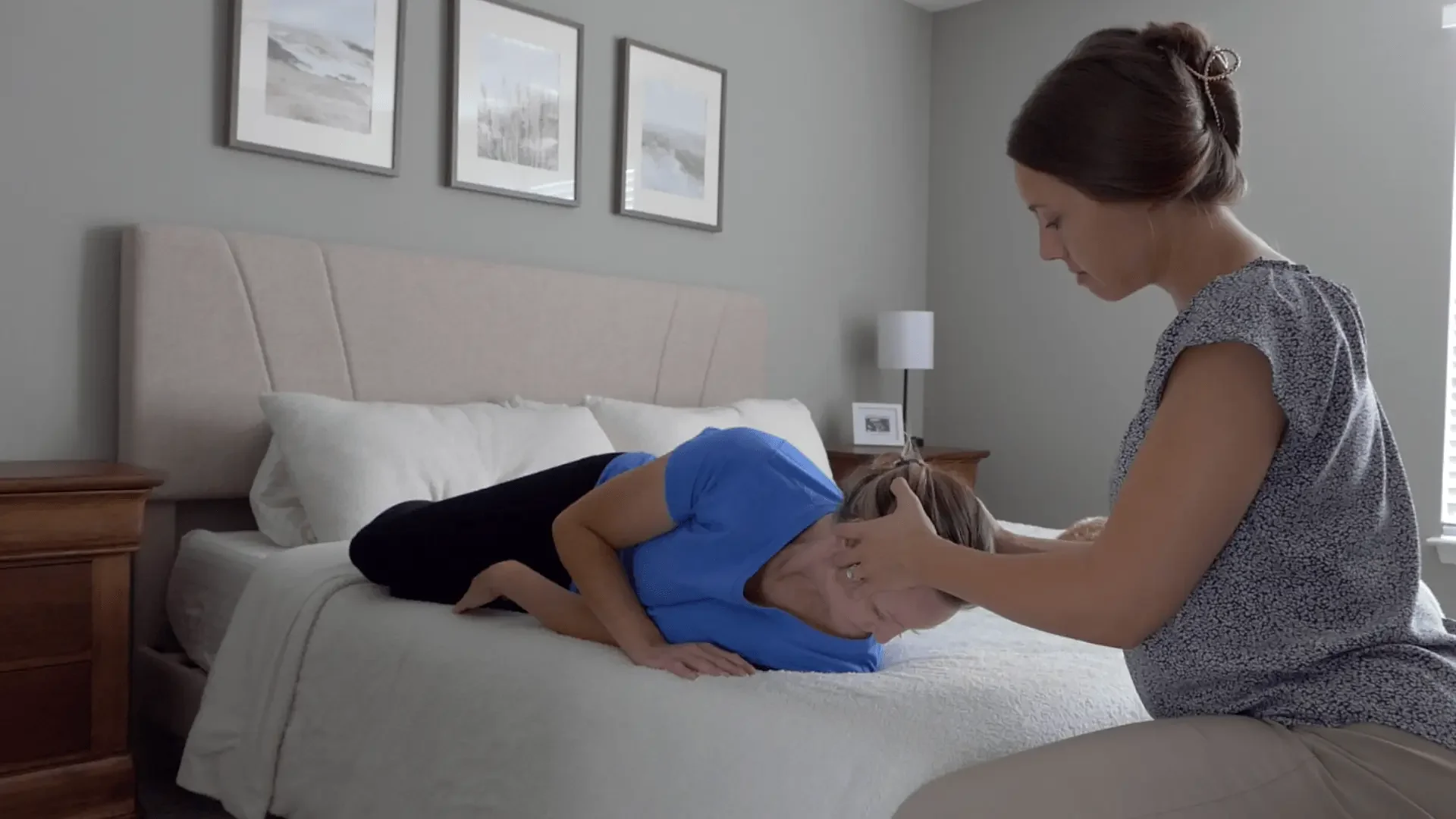
The Epley maneuver is a simple, non-invasive repositioning technique that moves displaced calcium crystals out of your inner ear's semicircular canals and back where they belong. When performed correctly by a trained specialist, it resolves BPPV symptoms in 80-98% of cases—often in a single session. If you've tried it at home from a YouTube video and it didn't work (or made things worse), you're not alone. The difference between DIY attempts and professional treatment often comes down to accurate diagnosis and proper technique.
You've probably seen the videos online. Someone lies on a table, their head is turned, and then they're moved through a series of positions. It looks straightforward enough. So you tried it. Maybe it didn't work. Maybe it made the spinning worse. Maybe you're not even sure you did it right.
Here's the thing: you're not doing anything wrong by wanting to help yourself. But the Epley maneuver is one of those treatments that looks deceptively simple while actually requiring precise execution and—most importantly—the right diagnosis first. Let's break down what the Epley maneuver actually is, why DIY attempts often fail, and when it makes sense to see a specialist.
What Is the Epley Maneuver?
The Epley maneuver is a repositioning treatment for BPPV (benign paroxysmal positional vertigo). It was developed by Dr. John Epley in 1980 and has become the gold standard treatment for the most common type of vertigo.
To understand why it works, you need to understand what's happening inside your ear. Deep within your inner ear, tiny calcium carbonate crystals called otoconia help you sense gravity and movement. Sometimes these crystals break loose and drift into one of the semicircular canals—the fluid-filled tubes that detect head rotation.
When those displaced crystals are floating where they shouldn't be, any head movement sends false signals to your brain. Roll over in bed? Spinning. Look up at a high shelf? Spinning. Bend down to tie your shoes? You guessed it—spinning.
The Epley maneuver uses gravity and a specific sequence of head positions to guide those loose crystals out of the canal and back into an area of the inner ear where they can be reabsorbed and won't cause problems. Think of it like tilting a marble through a maze—the angles and timing matter.
How Effective Is the Epley Maneuver?
When we're talking about treatments for dizziness, the Epley maneuver has one of the highest success rates of any intervention. Research consistently shows impressive results:
• 80-98% success rate when performed by a trained clinician [1]
• Many patients experience relief after just one treatment session
• Patients who receive the Epley maneuver are 6.5 times more likely to improve compared to those who receive medication alone [2]
• The procedure takes only 5-15 minutes to perform
Compare that to vestibular suppressant medications like meclizine, which only mask symptoms without fixing the underlying problem. The Epley maneuver actually solves the issue—when it's done right.
Why DIY Epley Attempts Often Fail
So if the Epley maneuver is so effective, why didn't it work when you tried it at home? There are several common reasons:
You Might Not Actually Have BPPV
This is the biggest one. The Epley maneuver only works for BPPV—specifically, posterior canal BPPV, which accounts for about 80% of cases. But there are many other causes of vertigo and dizziness that look similar:
• Vestibular migraines
• Vestibular neuritis
• Meniere's disease
• PPPD (Persistent Postural-Perceptual Dizziness)
• Cervicogenic dizziness
• Other canal variants of BPPV (horizontal or anterior canal)
If your dizziness isn't caused by crystals in the posterior canal, no amount of Epley maneuvers will help. You need a proper evaluation to determine what's actually going on. A specialist can identify the classic signs of BPPV and rule out other conditions.
The Wrong Ear Was Treated
BPPV typically affects one ear at a time. The Epley maneuver must be performed for the affected side. If you guess wrong and treat the healthy ear, you won't get better—and you might actually create a problem where there wasn't one.
A specialist uses a diagnostic test called the Dix-Hallpike maneuver to determine which ear is involved. They watch the direction and pattern of your eye movements (nystagmus) to identify exactly which canal is affected and which ear to treat.
Technique Errors
The angles, timing, and transitions in the Epley maneuver are more precise than they appear in YouTube tutorials. Common DIY mistakes include:
• Not turning the head far enough (should be 45 degrees)
• Moving too quickly between positions
• Not holding each position long enough for the crystals to settle
• Stopping mid-maneuver because the vertigo is too intense
• Not extending the head far enough off the edge of the surface
Anxiety Makes Everything Harder
When you try to treat yourself, you're already anxious. You know the spinning is coming. You tense up, you hesitate, you might not commit fully to each position. A specialist can guide you through it, keep you safe, and help you complete the full maneuver even when it triggers vertigo (which, by the way, is actually a good sign—it means the crystals are moving).
What Happens When a Specialist Does It
When you see a vestibular therapist for BPPV treatment, the process is thorough and personalized:
Step 1: Comprehensive evaluation. We don't just jump into treatment. First, we take a detailed history, ask about your symptoms, and perform diagnostic tests to confirm BPPV and identify which ear and canal are involved.
Step 2: Precise diagnosis. Using the Dix-Hallpike test, we watch your eye movements to determine exactly where the crystals are. This tells us whether the Epley maneuver is even the right treatment—or if you need a different approach.
Step 3: Expert execution. We perform the Epley maneuver with the correct angles, timing, and transitions. We support your head and guide you through each position safely.
Step 4: Verification. After the maneuver, we retest to see if it worked. If not, we can perform additional maneuvers or investigate other possible causes.
Step 5: Education and follow-up. We teach you what to do (and what to avoid) in the days following treatment, and we're available if symptoms return.
What If the Epley Maneuver Doesn't Work for Me?
While the Epley maneuver has excellent success rates, it doesn't work for everyone. If you've had the maneuver performed by a professional and you're still symptomatic, a few things might be happening:
• Different canal involvement: You might have horizontal canal BPPV (which requires different maneuvers like the BBQ roll or Gufoni) or anterior canal BPPV
• Cupulolithiasis: Instead of floating freely, the crystals might be stuck to the cupula (the sensory structure in the canal), requiring modified techniques
• Multiple canals: More than one canal might be involved
• Recurrence: BPPV can come back, especially in older adults or those with certain risk factors
• Different diagnosis entirely: Your vertigo might not be BPPV after all
A skilled vestibular specialist doesn't give up after one attempt. We troubleshoot, adapt, and keep working until we figure out what's going on. Vertigo is rarely something you just have to live with—there's almost always something that can be done.
When Should You See a Specialist Instead of Trying at Home?
Consider professional treatment if:
• You've tried the Epley maneuver at home and it didn't work
• Your symptoms got worse after attempting self-treatment
• You're not sure which ear is affected
• Your dizziness doesn't fit the classic BPPV pattern (brief spinning triggered by head movements)
• You have other symptoms like hearing loss, ear fullness, or headaches
• You've had multiple episodes of BPPV
• You're nervous about triggering intense vertigo on your own
Find BPPV Treatment in Indianapolis and Fishers
If you're dealing with vertigo and wondering whether the Epley maneuver could help, you don't have to figure it out alone. At Dizzy Free PT in Fishers, we specialize exclusively in vestibular conditions. We'll determine exactly what's causing your symptoms and provide the right treatment—whether that's the Epley maneuver, a different repositioning technique, or vestibular rehabilitation.
You deserve answers, not guesswork. And you definitely deserve to stop feeling like the room is spinning every time you move your head.
Ready to get your life back? Call us at (317) 804-1222 to schedule your evaluation.
We do more than treat symptoms — we listen, dig deep, and help you understand what's really going on. Through expert care, honest guidance, and a whole lot of support, we help you move from feeling overwhelmed to steady, confident, and back in control.
References
[1] Hilton MP, Pinder DK. The Epley (canalith repositioning) manoeuvre for benign paroxysmal positional vertigo. Cochrane Database of Systematic Reviews. 2014.
[2] Gaur S, et al. "Efficacy of Epley's Maneuver in Treating BPPV Patients: A Prospective Observational Study." International Journal of Otolaryngology. 2015.